Children's football shoes Nike


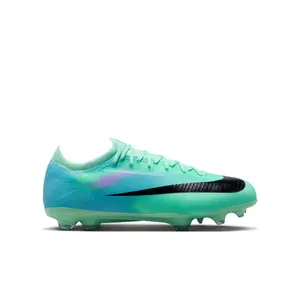


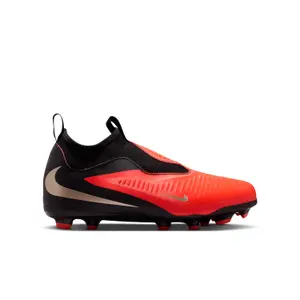
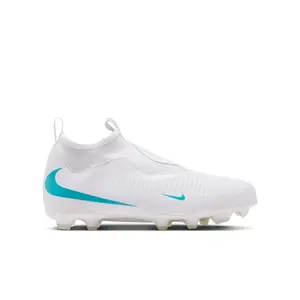


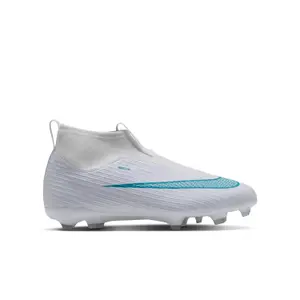


Starting at €79.99
€45.45
This page brings together the football boots Nike for kids available at Foot-Store, in junior sizes. You'll find moulded studs for natural grass, soles designed for synthetic surfaces, models with small studs for artificial turf, and indoor pairs, featuring the main lines of the brand like Mercurial, Phantom, and Tiempo.
To compare with other brands, you can go back to the full range of children's football boots.
What football shoes Nike can you find in this children's selection?
This page brings together football shoes Nike designed for children and juniors, meaning the same lines as those worn by adults, adapted for smaller and narrower feet. It includes studs for natural grass, versions made for synthetic turf, models with small studs for stabilised and hard synthetic surfaces, as well as flat-soled pairs for indoor play.
The major Nike families are represented: the Mercurial, the Phantom, and the Tiempo, available in several finishing levels. Generally, a single line exists in a high-end version, very lightweight and close to what professional players wear, and more accessible versions that maintain the same silhouette and sole but use different materials. For a child who grows quickly and changes shoe size from one season to the next, this choice between several quality levels often matters as much as the model itself.
Mercurial, Phantom, Tiempo: what do the Nike ranges correspond to?
Nike organises its football shoes into a few lines, each linked to a way of playing rather than a specific position. Here's how to distinguish them easily without getting into technical details that change with each new collection:
- The Mercurial, available in Superfly and Vapor, is the line historically built around speed and quick footwork. It is often the first choice for children who play on the wings or up front and who enjoy very lightweight shoes.
- The Phantom focuses on ball control, dribbling, and striking. It suits young players who touch the ball a lot in midfield or who seek accuracy in their passes and shots.
- The Tiempo remains the most classic line, primarily designed for comfort and foot support. It’s a safe bet for a child who is just starting, has slightly wider feet, or trains a lot during the week.
The differences between two models of the same line can vary from generation to generation: the best approach is to base the decision on the child's actual usage, the type of pitch they play on most frequently, and the comfort felt during fitting, rather than the name of the technology printed on the box.
FG, AG, TF, IC: which sole to choose based on the pitch?
The choice of sole is primarily determined by the type of pitch the child plays on most often, as it affects grip and comfort. The acronyms used by Nike appear on all boxes and are easy to read once you know the code.
- FG: moulded studs for dry or soft natural grass, the most common situation in clubs.
- AG: sole designed for synthetic turf, with more numerous and shorter studs.
- MG: a versatile sole designed to switch between natural and synthetic.
- TF: numerous small studs for stabilised, worn synthetic, and hard pitches, often used for training.
- IC: flat rubber sole for futsal and gym floors.
If the child plays in a club on grass and at school on concrete or synthetic, two distinct pairs last much longer than a single pair used everywhere. However, a sole intended for synthetic or stabilised surfaces withstands hard ground better than moulded studs for grass.
How to choose the right size for a child?
The right size is the one that leaves a very short space in front of the big toe, about the width of a child's finger, without the foot sliding inside. A football shoe fits more closely than an everyday trainer, as ball control and stability during footwork changes depend on it.
Measure the foot while standing, at the end of the day, with the sock worn in matches, and then compare it with the size guide for the desired model. Sizes vary between different Nike lines: a Mercurial is known to be narrower than a Tiempo, which can change the feel at the same size. Getting two sizes larger to make the pair last is a false economy, as the foot moves in the shoe and blisters can quickly occur.
Children's models are also available in versions with Velcro or laces depending on their age, a useful detail for younger ones who can’t yet tighten their shoes by themselves.
High-end Nike shoes or a more accessible model for a child?
For a child, the level of the range should be chosen mainly based on their growth rate and the number of training sessions per week. The most advanced versions of a line focus on lightweight materials, which appeals to players who are already regularly competing. More accessible versions maintain the same look and a sole suitable for the same terrain, but use thicker materials that can hold up well to repeated training.
A child who changes shoe size every season will wear their pair for only a few months. In that case, a mid-range model well-suited to the pitch often provides more value than a very technical shoe worn for half a season.
Nike, adidas, Puma, or Joma: compare before choosing
Each brand sizes its children's shoes differently, and it’s helpful to compare several pages before making a decision. Other selections by brand are accessible from the same level of the catalogue:
- The shoes adidas, with the lines that children recognise on the pitches, in junior sizes.
- The shoes Puma, an interesting alternative when Nike models are a bit tight.
- The shoes Joma, often chosen for training and hard pitches.
- The overview page of children's football shoes, to browse all brands at once and filter by size or type of sole.
Where to find the best deals on Nike children's shoes?
The best deals are concentrated on a few pages of the site, updated continuously, rather than on one-off offers. The children's deals page gathers junior items at reduced prices, and the clearance features pairs from the end of the collection, often in the most common sizes from previous seasons. When a new collection arrives, models from the previous generation shift to these pages without changing the sole or the type of pitch used.
The key sales follow this order throughout the year: the Black Friday kicks things off, followed by the end-of-year holidays, winter sales, and the French Days in spring. Seasonal promotions are grouped on the children's sale and special offers pages.
Conversely, if you’re looking for the latest Nike releases for the 2026/27 season, the children's new arrivals collect them as soon as they go live, and the page shipped in 24h is useful when a pair needs to be ready for the next match.
Frequently asked questions
Do Nike children's shoes fit like everyday shoes?
No, a football shoe should fit more snugly than a casual shoe, with only a small space in front of the toes. It’s common to stay with the same size as in everyday shoes, but the feel is noticeably tighter. The best option is to measure the foot and refer to the size guide for the model.
Can you play on synthetic pitches with FG studs?
It’s possible occasionally, but that’s not the intended use. FG studs are designed to sink into natural grass, and on a hard synthetic pitch, they wear out faster while transmitting more shock to the joints. For a child who regularly plays on synthetic, an AG or TF sole is more appropriate.
At what age can a child wear screw-in studs?
Metal screw-in studs are rarely offered in junior sizes and are not recommended for young players, whose joints are still growing. Moulded studs cover almost all situations encountered in football schools. If in doubt, the club coach can indicate what is permitted on their pitches.
Does a child need a high-top shoe?
The high-top is primarily a matter of comfort and preference, not a requirement. Some children enjoy the feeling of support at the ankle, while others find it uncomfortable to put on, especially younger ones. Both types exist in the children’s Nike lines, and trying them on is better than relying on technical specifications.
How to make a pair of Nike football shoes last?
The most effective way is to remove dirt after each match with a brush, without putting the pair in the washing machine or near a radiator, which can deform the material and detach the sole. Letting them dry at room temperature, with insoles removed, is usually sufficient. Alternating between two pairs when the child plays several times a week significantly extends their lifespan.